Why One Casino Spin Is a Poor Sample of the Game
A single casino spin is a poor sample of the game. Learn what one result can tell you, what it cannot, and how to frame a useful model.

A roulette ball lands on black, and a student writes down the result. That entry tells them what happened once. It does not, by itself, reveal whether the wheel’s design, the game’s rules, or the recorded result fit a broader probability model. For anyone asking what one casino spin can tell you, the answer begins with the limits of a sample.
At Đại học Khoa học và Công nghệ Hà Nội (USTH), the same distinction matters in classroom models and technical simulations: an observation is a piece of data, while a model is a set of assumptions used to interpret data. Those are related, but they are not interchangeable. A single result is a small note on the page, not the page’s entire argument.
What can one casino spin tell you?
It can identify the outcome of that spin, provided the result was recorded correctly. It can also be compared with a model that specifies the possible outcomes and the chance assigned to each. If a simplified model says a properly operated, fair two-color wheel gives red and black equal chances, one black result is compatible with that model.
Compatibility is not confirmation. The same result could also occur under other models, including ones with unequal chances. One observation usually leaves many explanations open. A single spin is like one tile from a mosaic: it has a definite color, but it cannot show the whole image.
That does not make the observation useless. It makes its proper role modest. One spin can illustrate how a model maps possible outcomes to chances; it cannot settle a broader question about the mechanism without additional information.
How do an outcome, a sample, and a model differ?
- Outcome: the specific result recorded, such as red or black.
- Sample: a collection of observations gathered under defined conditions.
- Model: a mathematical description of how outcomes are assumed to arise.
- Assumption: a condition built into the model, such as equal chances or independence between spins.
These terms answer different questions. The outcome says what happened. The sample gives a basis for describing observed behavior. The model says what behavior to expect if its assumptions are suitable. Confusing them can turn a clear calculation into an answer to the wrong question.
For example, a simulation can generate outcomes from a rule chosen by its programmer. If it assigns equal chances to red and black and treats spins as independent, it represents that particular model. It does not automatically represent every physical wheel or every casino procedure.
Why is one spin a weak basis for judging a wheel?
A single result contains little information about how a mechanism behaves across repeated use. If the question is whether observed behavior fits a proposed model, the relevant evidence must be gathered in a way that matches that question. Conditions should be stated, outcomes recorded consistently, and the model specified before interpreting the sequence.
Even a longer sequence is not a crystal ball. It can help assess whether a model deserves closer attention, but the conclusion depends on what was observed, how the observations were collected, and which alternatives were considered. A noticeable run of one color may prompt a question; it does not supply its own answer.
Casino games also involve rules and equipment that a casual observer may not know in full. A player should not treat a brief sequence as a basis for claims about bias or as a reason to expect a correction on the next spin. For decisions involving gambling, a useful boundary is simple: do not risk money on a pattern that the available information cannot support.
How should you frame a probability question?
Start by naming the question rather than starting with the most memorable result. Is the aim to describe one outcome, to model a sequence, or to assess whether a mechanism fits a stated model? Each aim needs a different kind of evidence.
- If the question is about one recorded result, identify the outcome and check that it was transcribed accurately; if the record is unclear, correct it before interpreting it.
- If the question is about possible outcomes, list them under the game’s stated rules; if a result is omitted, revise the model before using it.
- If the question is about assigned chances, state the assumptions behind those chances; if they are unknown, describe them as unknown rather than guessing.
- If the question is about repeated behavior, define what counts as an observation and how conditions will be kept comparable; if conditions change, separate the records or reconsider the model.
- If the question is about dependence, ask whether one event changes the conditions for the next; if it does, use a model that accounts for that change instead of assuming independence.
- If the question is about a physical wheel, distinguish observations from claims about its mechanism; if there is a concrete concern, leave assessment to qualified, authorized personnel rather than inferring it from a short run.
This is not a recipe for proving that a wheel is fair. It is a way to keep the claim proportionate to the information available.
How does a single observation fit into a classroom model?
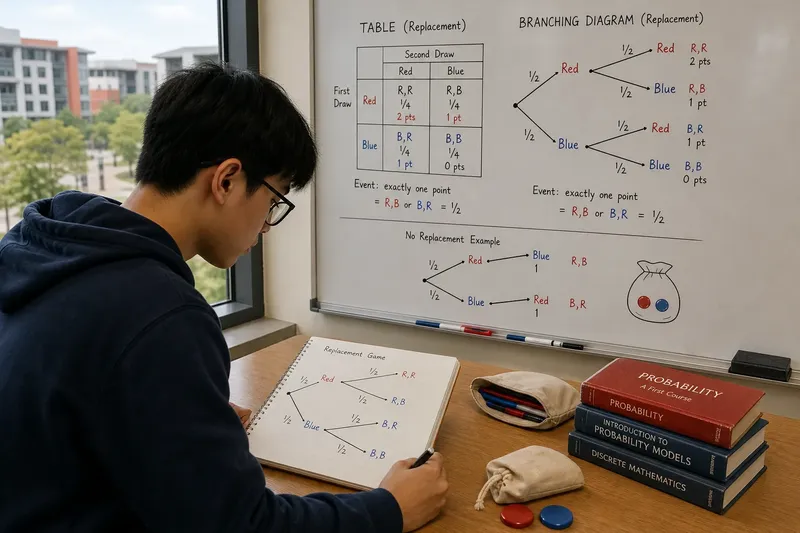
Say a USTH student is asked to compare a simple two-color model with a recorded sequence. The starting inputs are a written rule that assigns equal chances to red and black, an assumption that each simulated spin is independent, and a record containing black followed by red. The student first checks that the two outcomes are listed in the rule, then checks that both entries were copied correctly. Next, they compare the record with the model: both outcomes are allowed, so the sequence does not contradict the stated assumptions. The resulting answer is narrow but useful: these two observations fit the model, yet they do not establish that a real wheel follows it. The student keeps the model as a teaching example and avoids drawing a conclusion about physical equipment.
That example shows why the wording of the question matters. “Did these outcomes fit the rule?” can be answered from the stated rule and the record. “Is this real wheel fair?” asks about a mechanism and requires evidence beyond a pair of results. The same data do not answer both questions just because they appear in the same notebook.
What do readers ask about one casino spin?
Does one result reveal the next outcome?
No, not unless the setup supplies information that changes the chances for the next event. Under an independent model with unchanged conditions, the previous result does not alter the model’s next-spin probabilities.
Can one spin establish that a wheel is fair?
No. A result may be compatible with a fair-wheel model, but compatibility is not proof that the physical mechanism follows that model.
Can a long sequence settle the question?
A well-collected sequence can provide more information than one observation, but interpretation still depends on the model, collection method, and conditions. It does not identify a mechanism automatically.
When should a model be changed?
Change or qualify a model when its stated assumptions do not match the process or when relevant conditions are known to differ. Do not revise it merely because one result looks surprising.
What is the useful conclusion from one spin?
One casino spin tells you which outcome occurred, and little more about the game as a whole. Its value lies in being recorded and interpreted precisely: as an observation to compare with a clearly stated model, not as a verdict on the mechanism or a forecast of the next result.
For the search question of what one casino spin can tell you, keep the answer tied to its scope. State the outcome, name the assumptions, and separate a classroom model from claims about real equipment. That small discipline makes probability clearer—and keeps a single mark in a notebook from being asked to do the work of an investigation.