A Rainy-Day Casino Film Session for Curious Viewers
A rainy-day casino film session turns one fictional scene into a focused lesson on chance, technology, and the certainty a story asks you to accept.
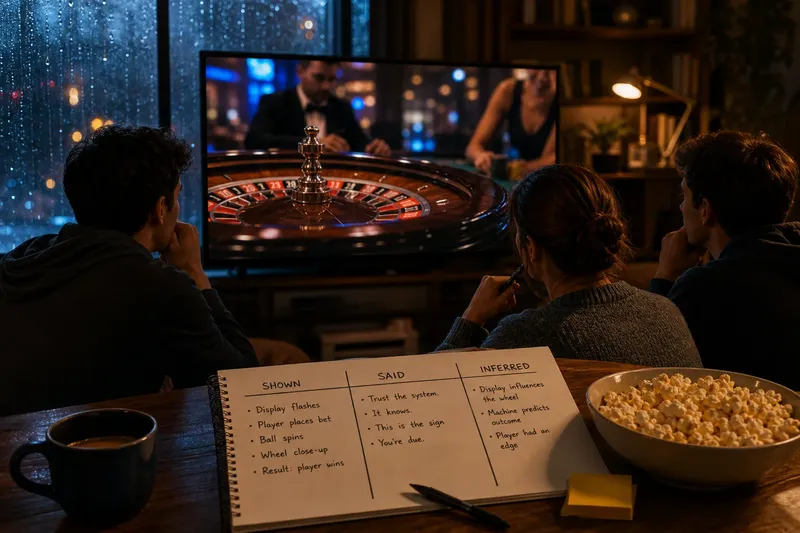
The rain has settled in, the film is queued, and a casino scene is about to make a sequence of lights and cards feel like a verdict. A rainy-day casino film session can turn that familiar bit of drama into a small exercise in noticing: what happened, what the characters think it means, and what the camera wants you to believe.
Choose one fictional scene, not an entire film to dissect. The aim is to watch closely without treating a screenplay as a probability lesson or a casino as a laboratory. A scene can still raise useful questions about chance, technology, and certainty, provided viewers keep track of where evidence ends and storytelling begins.
Why does the scene feel harder to read than expected?
A casino scene often moves quickly. Music rises, a character makes a choice, and the edit jumps to the result. Viewers may come away remembering the dramatic outcome but not the sequence that produced it. That is not a failure of attention; it is part of how the scene is built.
Start by lowering the assignment’s demands. Pick one sequence with a clear beginning and end: a bet, a draw, a reveal, or a character reacting to a result. Ignore the rest of the plot for now. A scene that lasts only a few minutes can offer more to discuss than a whole film watched with a notebook and a sense of duty.
Before viewing, agree on a simple distinction: observe first, interpret second. “The screen shows a card turning over” is an observation. “The machine knew what the character needed” is an interpretation. Keeping those separate is like sorting loose screws before trying to repair a shelf; the parts are easier to handle once they are not all in one pile.
What should you watch before discussing the outcome?
On the first viewing, follow the scene rather than pausing to solve it. Notice who acts, what information is visible, what is concealed, and when the audience learns the result. A brief note is enough. Detailed transcription tends to turn a relaxed film session into a committee meeting about camera angles.
On a second viewing, if the scene warrants one, watch for the machinery of presentation. Look at the cuts, sound, close-ups, displays, and reactions. Ask whether the film shows a process, or only the moment that makes the process feel meaningful. A roulette wheel, a card table, or a slot-machine display may be recognizable set dressing, but its appearance alone does not tell you how an outcome was produced.
Keep the observations concrete:
- What does the character know before acting?
- What does the viewer know at the same point?
- Which objects or screens appear to supply information?
- Does the scene show an outcome, a process, or both?
- What sound or edit makes the result feel important?
These questions do not require technical knowledge of casino equipment. They help viewers identify what the film has actually put on screen. If the scene leaves a detail unstated, record it as unknown instead of filling the gap with a confident guess.
Why does a random outcome look like a clue?
Stories give events a shape. A character notices a pattern, makes a choice, and receives a result. The order encourages viewers to connect those moments, even when the scene has not established that the first event caused the next one. Editing can make coincidence feel like a message; a reaction shot can make a result seem as though it had been waiting for its recipient.
Separate the event from the story built around it. Ask what happened in the scene, then ask what the character believes happened. A successful guess may reflect skill, luck, hidden information, or a script that needs the character to succeed. Unless the film supplies evidence, viewers cannot tell which explanation is meant to be true within the fictional world.
It also helps to distinguish possibility from prediction. A result can be possible without being foretold. Characters may talk as if a run of outcomes has a direction, but dialogue is not a demonstration. A screenplay can use confident language because confidence makes a good scene, not because the scene has established a reliable rule.
What if the technology seems to know too much?
Casino films often show terminals, screens, cameras, or mechanical devices as if they could read a person’s next move. Treat that as a claim made by the scene, not a fact supplied by the prop. A display may provide information, decorate the frame, or act as a visual shortcut for “the system.” The film has to show how it connects to an outcome before viewers can assess that connection.
Ask what the device is shown doing. Does it display a result after it happens? Does a character use it to make a decision? Does the camera merely cut to it at a tense moment? These are different roles. A screen that appears beside a character’s lucky result may be part of the staging rather than the cause.
For a compact discussion, draw three columns on paper: “shown,” “said,” and “inferred.” Put visible actions in the first, dialogue in the second, and conclusions viewers are tempted to make in the third. If a claim about the machine lands in “inferred,” the scene may be inviting a leap rather than giving an explanation.
How can the group keep the discussion grounded?
People bring different levels of familiarity with probability, films, and casino settings. A useful conversation does not require everyone to agree on a technical answer. It needs a shared description of the scene and a clear way to mark uncertainty.
Try this order:
- Describe the visible action without assigning a cause.
- Identify what the characters claim or believe.
- Point to the editing, sound, or device that shapes the audience’s impression.
- List any missing information that would change the interpretation.
- Offer a reading of the scene, while naming what remains uncertain.
Say you choose an invented scene in which a fictional player sees a flashing display, places a bet, and wins after a close-up of a wheel. The group first records the display, bet, and result as visible events. Then it notes that the film does not show the display affecting the wheel; the expected discussion result is a distinction between the scene’s dramatic suggestion and a demonstrated causal link.
That distinction can keep the conversation lively without turning it into a contest over who knows the most. If someone notices a detail others missed, ask where it appears in the scene. If the detail comes from outside the film, label it as outside knowledge. The point is not to forbid context, but to avoid quietly treating an assumption as something the camera showed.
What if viewers disagree about what happened?
Disagreement often comes from different memories of a fast edit. One person recalls the display before the bet; another remembers it appearing after the reveal. Instead of arguing from memory, replay only the relevant moment if that is practical. If not, keep both accounts on the page and mark the timing as unresolved.
A second source of disagreement is the difference between what a scene implies and what it confirms. One viewer may read a character’s glance as recognition; another may see only a reaction shot. Ask what visible detail supports each interpretation. If neither account can point to a clear cue, the honest answer may be that the film leaves it open.
Do not settle every dispute by searching for a real-world explanation of the equipment. A fictional scene can depart from ordinary practice, and a technical answer may not resolve what the director intended. For this session, the film’s evidence is the subject. Outside facts can be a separate conversation, not a substitute for watching.
What questions help after the credits?
How can I tell chance from skill in a scene?
Look for what the film shows the character doing before the outcome, and whether it connects that action to relevant information. A confident expression or successful result does not, by itself, establish skill.
Does a dramatic streak mean the next result is predictable?
Not on its own. A sequence may be meaningful to the characters or the plot while offering no basis for predicting what comes next.
Can a screen or camera prove that a system controls an outcome?
No single prop establishes that claim. Notice whether the scene shows a mechanism linking the device to the result, or merely places them close together in the edit.
What if the film never explains the rules?
Record that omission as part of the scene. Viewers can discuss the impression it creates without inventing a rule the film did not provide.
What if the session starts to feel like homework?
Reduce the scope. One scene, a few questions, and a short conversation are enough. Skip the second viewing if the first has already made the relevant details clear. The occasion is a rainy-day film session, not an examination disguised as a bowl of popcorn.
If the scene contains more than one possible focus, choose only one for the evening. You might discuss how sound makes an outcome feel inevitable, or how a device is presented as an authority. Trying to cover chance, editing, character motives, casino history, and probability all at once usually produces a list of topics rather than a useful exchange.
Let the group stop at an open question. “The film suggests that the display mattered, but does not show how” is a complete observation. It does not need a forced answer to count as analysis. Some stories use uncertainty as a dramatic tool, and viewers can notice that without repairing the script.
How can you carry the idea beyond the film?
Use the same separation of observation, claim, and inference when a screen or story presents a confident account of chance. Ask what is directly visible, what someone says it means, and what evidence would be needed to connect the two. This is a modest habit, not a verdict on every display or dramatic scene.
A rainy-day casino film session works best when it leaves viewers more alert to the gap between an event and the meaning attached to it. Keep the scene’s claims inside the fictional frame, and keep unknowns labeled as unknown. The next time a soundtrack turns a random reveal into a moment of certainty, you can enjoy the timing while noticing exactly how the film earned that feeling—or how little it showed.